Yoga for Beginners: How to Start Your Practice at Home

Complete guide to yoga for beginners. Learn how to start yoga at home with essential equipment, 10 basic poses, breathing techniques, and sample routines.
· by Jordan Reeves

Yoga for Beginners: How to Start Your Practice at Home

When it comes to yoga for beginners starting at home, making the right choice matters. I walked into my first yoga studio in 2018 with a borrowed mat that smelled like someone else’s feet and a head full of Instagram-fueled expectations. Within fifteen minutes I was sweating through poses I couldn’t hold, comparing myself to the woman next to me who was folded into a pretzel without breaking a sweat, and silently calculating whether I could sneak out the back door without anyone noticing. That experience almost convinced me that yoga wasn’t for me. What I didn’t understand at the time was that yoga for beginners doesn’t require a studio, doesn’t require a room full of flexible strangers, and absolutely doesn’t require you to know what you’re doing on day one. Starting yoga at home gave me the space to learn at my own pace, make mistakes without an audience, and build a practice that actually stuck. This guide is everything I wish someone had handed me before I ever unrolled a mat—a complete roadmap for starting yoga at home with confidence, minimal equipment, and zero pretension.

Why Start Yoga at Home

The case for starting yoga at home is stronger than most people realize. I’m not saying you should never go to a studio—studios offer community, hands-on adjustments, and the energy of group practice that can be genuinely transformative. But for absolute beginners, the home environment solves several problems simultaneously.

First, it removes the intimidation factor. A 2019 survey by Yoga Alliance found that 37% of non-practitioners cited feeling self-conscious about their fitness level or flexibility as a barrier to starting yoga. When you practice at home, nobody is watching your Downward Dog. You can wobble, fall, curse under your breath, and try again without a shred of embarrassment. That psychological safety is invaluable during the early stages when you’re building both competence and confidence.

Second, it eliminates scheduling friction. Studio classes run on fixed schedules. If your class is at 6 PM but you get stuck in traffic, you miss it. If the only beginner class is at 7 AM on Saturday and you’re not a morning person, you’re out of luck. A home practice fits around your life, not the other way around. When I first started, I practiced at 9 PM after my kids were asleep, in my living room, with a YouTube video on my laptop propped against a chair. That flexibility—both literal and metaphorical—kept me consistent when a studio membership would have gathered dust.

Third, it costs almost nothing. Entry-level studio memberships in most U.S. cities run between $79 and $150 per month. Drop-in classes average $15 to $25. For less than the cost of two drop-in sessions, you can buy a decent mat and access thousands of hours of free instruction online. The financial barrier to yoga is entirely artificial. You don’t need a $100 monthly unlimited pass to learn Sun Salutations.

The research backs this up. A 2020 study in the International Journal of Yoga randomized 80 sedentary adults into a home-based yoga group and a control group. After 12 weeks, the home practitioners showed significant improvements in flexibility, balance, and perceived stress compared to controls, with 78% still practicing at the six-month follow-up—a remarkably high adherence rate for any exercise intervention. The researchers attributed this to the low barrier to entry and the self-paced nature of home practice. You don’t need a boutique studio to get the benefits. You need a mat, some guidance, and the willingness to show up.

What You Actually Need: Equipment

Let me save you the mistake I made: I bought a $12 mat from a department store, two pairs of overpriced yoga pants I never wore, a block I didn’t know how to use, and a strap that gathered dust in my closet for three years. Total waste of money. Here’s what you actually need, in order of importance.

The Bare Minimum

A yoga mat. This is the single piece of equipment that determines whether your practice feels stable or like an ice-skating accident. For beginners, a 5mm mat provides the best balance of cushioning and grip. Anything thinner than 3mm and your knees will complain in tabletop poses. Anything thicker than 6mm and you’ll feel disconnected from the floor, which undermines balance poses. Material matters too. PVC mats offer the best grip and durability at entry-level prices, but they’re not eco-friendly. TPE and natural rubber are more sustainable alternatives with good traction, though rubber can have a strong smell for the first few weeks. If you want a deeper breakdown, I spent hours comparing materials, thicknesses, and price points in the yoga mat buying guide. It walks through every decision point so you don’t end up buying twice.

Don’t practice on carpet without a mat. I tried it. The carpet bunches up, your hands slide around, and you’ll spend more energy stabilizing than stretching. If carpet is your only option, look for a mat with a textured underside designed specifically for carpet grip—the how to choose a yoga mat for beginners guide covers that scenario in detail.

Comfortable clothes. You don’t need Lululemon. You need clothes that let you move freely and won’t ride up, slide down, or bunch uncomfortably when you’re upside down or folded forward. Leggings or loose shorts with an elastic waistband. A fitted T-shirt or tank top—loose shirts slide up in Downward Dog and fall over your face in forward folds. Bare feet, always. Socks on a yoga mat are a recipe for slipping.

Water. Keep a full bottle within arm’s reach. You won’t need it constantly during a twenty-minute session, but you’ll want it available during the first few sessions when your body is working harder than it’s used to.

A quiet, clutter-free space. You need roughly 6 feet by 3 feet—the dimensions of a standard yoga mat with a little extra room around the edges. Clear furniture out of arm’s reach. If you’re tall, give yourself a bit more overhead clearance for reaching poses. I practice in the corner of my living room, facing a blank wall, with my mat unrolled parallel to the baseboard. The simplicity of the space helps me focus. You don’t need candles, incense, or a Buddha statue. You need a rectangle of floor where nobody will trip over you.

Nice-to-Have Equipment

These items aren’t essential on day one, but they’ll make certain poses accessible much sooner than they would be otherwise—and for some beginners, they’re the difference between frustration and progress.

Two yoga blocks. I resisted buying blocks for my first six months because I thought they were for people who couldn’t do the “real” pose. That was ego talking, and it cost me months of proper alignment. Blocks bring the floor closer to you. In Triangle Pose, a block under your bottom hand lets you keep your spine long instead of collapsing sideways. In Half Moon, a block under your supporting hand gives you the stability to explore balance without fear. In Seated Forward Fold, blocks under your knees can relieve hamstring strain. Foam blocks are lighter and more comfortable. Cork blocks are heavier and provide more stability. Either works. Start with one or two—two is better because symmetry. If you don’t have blocks, a stack of thick books works as a temporary substitute, but actual blocks are wider and grippier, which matters for stability.

A yoga strap. A strap is essentially an arm extender. If your hamstrings are tight—and for most desk-bound beginners, they are—a strap lets you reach your feet in seated poses and supine hamstring stretches without rounding your spine. Look for a strap at least six feet long with a D-ring or cinch buckle. A belt or a long scarf works in a pinch, but a proper cotton strap is less slippery and easier to adjust.

A blanket or firm cushion. A folded blanket serves multiple purposes: under your knees in tabletop poses for cushioning, under your sitting bones in seated poses to tilt your pelvis forward, under your head in Savasana for neck support, and over your body in relaxation poses when your temperature drops. A standard fleece or wool throw blanket folded into a firm rectangle is ideal.

The yoga equipment for beginners guide details every prop I recommend and the order to buy them in, so you build your kit gradually instead of accumulating a closet full of yoga gadgets you’ll never use. Start with the mat. Add blocks and a strap in your second or third week if you notice certain poses feel inaccessible. The blanket you already own.

If you’re ready to shop, Amazon’s yoga mat category is the most efficient place to compare options across every price point with real customer reviews. I’ve bought mats there for years because the selection, pricing, and return policies make it low-risk to find what works.

Setting Up Your Practice Space

The physical space shapes your mental space more than you might think. When I first started, I’d shove my coffee table against the wall, unroll my mat in the gap, and practice sandwiched between furniture. It worked, but it felt like I was squeezing yoga into my life rather than making space for it. The shift happened when I designated a permanent practice area—even though it was just the same six-by-three-foot rectangle of floor.

Your space doesn’t need to be a dedicated yoga room. It needs to be consistent. Pick a spot in your home that you can use at the same time each day or week without disruption. A corner of the bedroom. A section of the living room. A spot in the basement if you have one. Keep your mat unrolled if you have the space—the visual cue of a mat ready to go reduces the friction of starting. If you need to roll it up between sessions, store it somewhere visible, not hidden in a closet. Out of sight, out of mind is real.

Consider the floor surface. Hardwood or tile is ideal because it’s firm and stable. Carpet is less ideal—it’s soft, which destabilizes balance poses, and it bunches under a mat. If you’re on carpet, a thicker mat (6mm) compensates for some of the softness, and a mat with a grippy underside prevents bunching.

Lighting matters more than you’d expect. Harsh overhead lights make relaxation hard. Natural light is best, but if you’re practicing in the evening, a lamp with a warm bulb placed at floor level creates a softer atmosphere. I practiced in near-darkness for my first few months and didn’t realize how much the lighting was affecting my mood until I added a small lamp near my mat. The difference was genuinely noticeable.

Temperature is another variable. Yoga generates body heat, but not enough to warm a cold room. If your practice space is chilly, do a more vigorous warm-up or wear an extra layer you can remove as you heat up. If it’s hot, stay hydrated and consider a mat towel—sweaty hands on a mat are a slipping hazard.

10 Foundational Poses for Beginners

When I teach beginner workshops, I don’t throw thirty poses at my students and hope something sticks. I teach ten poses—the ones that form the backbone of virtually every yoga sequence you’ll ever encounter. Master these ten, and you’ve built a vocabulary that unlocks thousands of classes. Each pose below includes exactly what I tell my students in person: how to get into it, what you should feel, what to watch out for, and how to modify it for your body.

1. Mountain Pose (Tadasana)

Mountain Pose looks like standing. It’s not. It’s the architectural blueprint for every standing pose in yoga, and getting it right makes Warrior I, Warrior II, Triangle, and Tree Pose dramatically more accessible.

Stand with your feet hip-width apart. Distribute your weight evenly across all four corners of each foot—the base of the big toe, the base of the pinky toe, and both sides of the heel. Lift your arches slightly. Engage your quadriceps by drawing your kneecaps upward without locking your knees back into hyperextension. Micro-bend them so subtly that someone watching wouldn’t notice. Tuck your tailbone under just enough to neutralize your pelvis—if your lower back is excessively arched, you’ll feel it release. Lengthen through your spine as if a string is pulling through the crown of your head. Roll your shoulders up toward your ears, then slide them down your back. Arms hang naturally at your sides, palms facing forward if you want an extra chest opener. Breathe deeply and steadily. Unclench your jaw. Hold for five to eight breaths.

What you should feel: Grounded stability through your feet, a gentle lift through your spine, and a buoyant, open quality in your chest. Your breath should feel full and unrestricted.

Common mistake: Locking the knees back into hyperextension. It feels stable but puts stress on the knee ligaments. Keep a micro-bend.

Modification: If balance is a challenge, separate your feet wider than hip-width. There’s no rule that Mountain Pose has to be narrow.

2. Downward-Facing Dog (Adho Mukha Svanasana)

This is the pose everyone pictures when they hear the word yoga. It’s also the pose that made me want to quit for the first month. Hamstrings screaming, wrists aching, shoulders burning—it was genuinely uncomfortable. But here’s what nobody told me: Downward Dog becomes a resting pose once your body adapts. The keyword is adapts, and adaptation takes time.

Start on hands and knees in a tabletop position. Wrists directly under shoulders, knees under hips. Spread your fingers wide—I mean really wide, gripping the floor with each finger pad. Tuck your toes under, press into your hands, and on an exhale lift your hips up and back toward the ceiling. Your body forms an inverted V shape. Now the critical instruction most beginners miss: bend your knees. Yes, bend them. I don’t care if the instructor on the video has heels flat on the floor and legs straight as boards. Your priority is a long, straight spine. If bending your knees deepens the fold at your hips and straightens your back, that’s exactly what you’ll do. Pedal your feet gently—bend one knee while pressing the opposite heel toward the floor, alternating sides. Hold for five to ten breaths.

What you should feel: A deep stretch through your shoulders and the back of your legs, but not sharp pain. Your spine should feel long, not compressed. Your hands should feel rooted and active.

Common mistake: Forcing heels toward the floor at the expense of a rounded spine. Spine length first, heels second. Always.

Modification: Bend your knees as much as needed. Place blocks under your hands if wrist pain is an issue. Widen your hand placement if shoulder tightness is present.

3. Cat-Cow (Marjaryasana-Bitilasana)

When my lower back started aching from twelve-hour desk days, a physical therapist told me to do ten rounds of Cat-Cow every morning. I rolled my eyes but complied. Three weeks later, my back pain had dropped by at least fifty percent. This pose isn’t flashy, but it’s the most important spinal maintenance movement you’ll ever learn.

Start on hands and knees. Wrists under shoulders, knees under hips. On an inhale, drop your belly button toward the floor, lift your chest forward and up, and tilt your tailbone toward the ceiling. Your gaze follows your chest but don’t crank your neck. On the exhale, reverse everything: tuck your tailbone, round your spine up toward the ceiling like a Halloween cat, and let your head drop heavy. Move with your breath—if your inhale is four seconds, Cow lasts four seconds. If your exhale is five seconds, Cat lasts five seconds. Do eight to ten rounds.

What you should feel: A fluid, wavelike motion through each vertebra. Think of your spine as a string of pearls moving one at a time.

Common mistake: Only moving from the lower back or neck while the mid-back stays frozen. The entire spine participates.

Modification: Try it on your forearms if wrist pressure is uncomfortable. Place a folded blanket under your knees for cushioning.

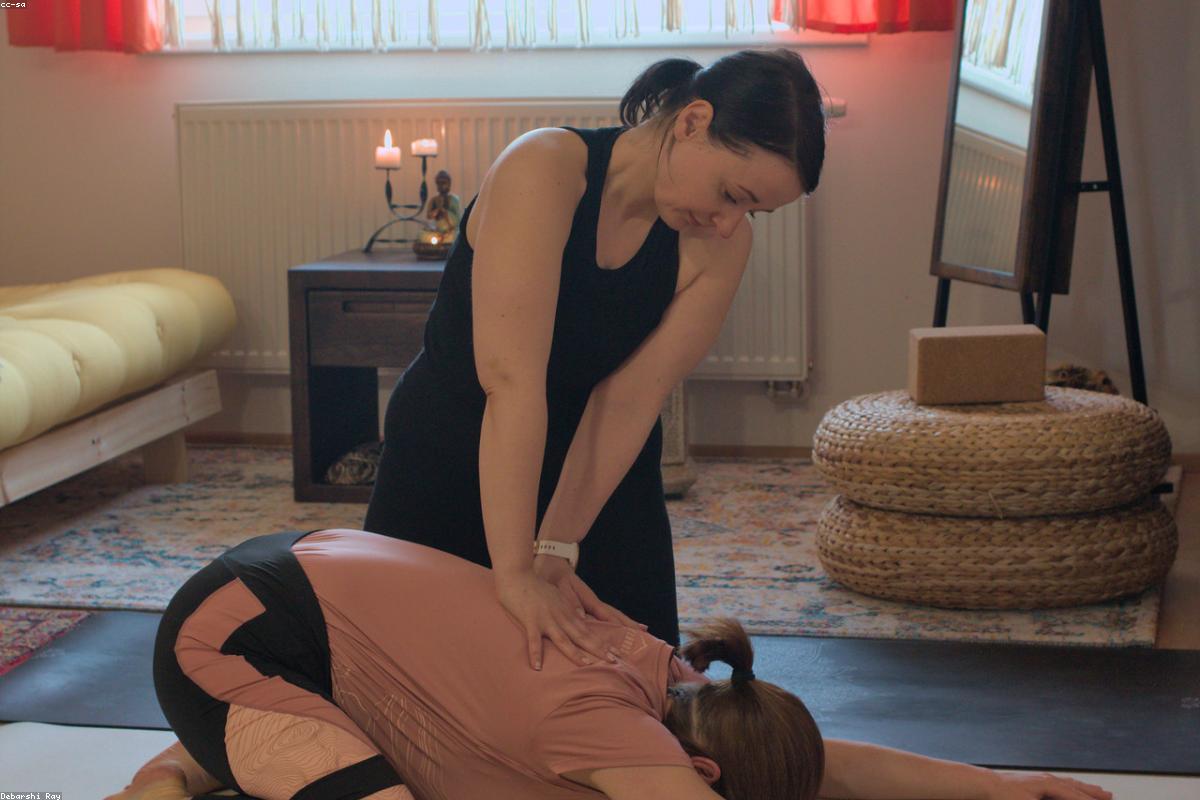
4. Child’s Pose (Balasana)

Child’s Pose is your reset button. Any time your breathing gets ragged, your mind starts racing, or a pose feels like too much, drop into Child’s Pose. I didn’t appreciate this pose until year three of my practice, and I regret every minute I spent white-knuckling through discomfort when I could have simply rested.

From hands and knees, bring your big toes to touch and separate your knees wide enough for your torso to fit between your thighs. Sit your hips back toward your heels. If your hips hover above your heels, that’s completely fine. Extend your arms forward along the floor or rest them alongside your body with palms facing up. Let your forehead rest on the mat or on a block if it doesn’t reach. Breathe slowly and deeply. Stay for one to three minutes or longer.

What you should feel: A deep release in your lower back and a sense of surrender. The floor holds you up—let it.

Common mistake: Keeping shoulders shrugged up toward your ears. Actively soften them away from your ears. Relax your jaw and forehead too.

Modification: Place a bolster or folded blanket between your thighs and calves if your hips don’t reach your heels. Stack your fists or a block under your forehead if it doesn’t reach the floor.

5. Standing Forward Fold (Uttanasana)

When I first tried Standing Forward Fold, my fingertips barely reached my knees. I’d resigned myself to the “naturally tight hamstrings” identity. Turns out, hamstrings respond to consistent, patient attention like any other muscle group. Three years in, my palms rest flat on the floor most days—not every day, and that’s okay.

Stand in Mountain Pose with your hands on your hips. On an inhale, lengthen your spine. On an exhale, hinge at your hip crease—not your waist—and fold your torso forward. Think of your hip bones drawing back as your heart reaches forward. Let your arms and head hang heavy. Bend your knees generously. Grabbing opposite elbows creates a gentle sway that releases tension in the spine and neck. Hold for eight to ten deep breaths.

What you should feel: A stretch through your hamstrings and calves, and a decompression sensation along your spine as gravity provides gentle traction.

Common mistake: Hinging from the waist and rounding the spine to reach the floor. The fold comes from your hip joints, not from curling your back into a ball.

Modification: Deeply bend your knees. Place blocks under your hands if the floor feels miles away. Hands on shins is a completely valid expression of this pose.

6. Warrior I (Virabhadrasana I)

I used to hate Warrior I. My hips felt bound up, my shoulders ached, and I couldn’t figure out the hip alignment. Then an instructor adjusted my back heel angle by ten degrees, and the entire pose clicked. One tiny change made everything fall into place.

From Downward Dog, step your right foot between your hands. Your front knee stacks directly over your front ankle at roughly 90 degrees. Spin your back heel down at about a 45-degree angle—this is the adjustment that changed everything for me. Square your hips toward the front of your mat. This is genuinely difficult. Your hips will want to open to the side, and that’s a different pose (Warrior II). From your squared hips, sweep both arms overhead with biceps alongside your ears and palms facing each other. Your back leg stays strong and straight without locking. Hold for five to eight breaths, then switch sides.

What you should feel: Strength in your front quadriceps and glutes. Your back leg should feel engaged through the outer hip and calf. Your core is slightly engaged to support the upright torso.

Common mistake: Letting the front knee collapse inward. Your knee tracks over your second and third toes. Actively press the knee outward by engaging the outer hip.

Modification: Shorten your stance if balance is a challenge. Widen your stance side-to-side for more stability. Bring hands to hips if shoulder mobility is limited.

7. Warrior II (Virabhadrasana II)

Warrior II taught me more about stamina than any cardio workout. Holding this pose for five full breaths when you’re new feels like an eternity. Your front thigh burns, your arms feel like they weigh fifty pounds each, and the trick is breathing through it without letting your form collapse.

From Downward Dog, step your right foot between your hands. Spin your back heel down so the back foot is roughly parallel to the back edge of your mat. Your front heel should align with the arch of your back foot. Bend your front knee so it tracks over your ankle, ideally to 90 degrees but not forced. Open your hips to the long side of your mat. Extend your arms parallel to the floor, reaching actively through your fingertips. Gaze over your front middle finger. Keep your torso upright—shoulders stacked over hips. Hold for five to eight breaths, then switch sides.

What you should feel: A deep burn in your front quadriceps and glutes. Extended, fully engaged arms. The back leg is strong and the outer edge of your back foot presses into the mat.

Common mistake: Leaning the torso forward over the front knee. Your shoulders should stack directly over your hips. Pull your upper body back and keep your chest open to the side.

Modification: Shorten your stance if knee strain is too much. Rest your hands on your hips if your arms fatigue. Keep your gaze forward instead of over the hand if your neck feels strained.

8. Tree Pose (Vrksasana)

I spent two months falling out of Tree Pose in every single session. I’d plant my foot, raise my hands, and within three seconds I’d be wobbling like a flagpole in a storm. The single biggest lesson I learned: look at something that isn’t moving. A spot on the floor, a mark on the wall. Your gaze is your anchor. Also—and I cannot stress this enough—your foot does NOT go on your knee. Ever.

From Mountain Pose, shift your weight into your left foot. Ground through all four corners of that foot. Bend your right knee and place the sole of your right foot on your left inner ankle, left calf, or inner thigh—above or below the knee joint, never directly on it. Press your foot and your standing leg firmly into each other. Find a fixed point to gaze at. Once stable, bring your hands to your heart center or lift them overhead. Hold for five to eight breaths, then switch sides.

What you should feel: A surprising amount of work in your standing ankle and foot as micro-adjustments fire constantly. Your core should be lightly engaged. The foot against your standing leg presses actively.

Common mistake: Placing the foot on the side of the knee joint. This creates dangerous lateral pressure on a joint that only hinges forward and backward. Foot goes on the thigh or below the knee. Period.

Modification: Keep your toes on the floor as a kickstand. Place your hand on a wall for balance. Keep your hands at heart center rather than overhead.

9. Cobra Pose (Bhujangasana)

Cobra is the beginner’s introduction to backbending, and it’s the pose that taught me to stop muscling through movements with my lower back. The lift in Cobra comes from your upper back and chest, not from jamming your lumbar spine into compression.

Lie on your belly with your legs extended behind you and the tops of your feet pressing into the mat. Place your hands under your shoulders, elbows tucked in toward your ribs. Press the tops of your feet and your pubic bone firmly into the floor—this anchors your lower body and protects your lower back. On an inhale, lift your chest off the floor by engaging your back muscles. Your hands support the lift but don’t do all the work. Keep your elbows slightly bent. Your gaze stays forward or slightly down—don’t crank your neck back. Hold for three to five breaths, then lower on an exhale.

What you should feel: Activation through your entire spine, especially between your shoulder blades. A gentle stretch across your chest and the front of your shoulders. No compression or pinching in your lower back.

Common mistake: Pushing up aggressively with the arms and dumping the lift into the lower back. The lift comes from your spinal muscles, not your arms. Keep your pubic bone and the tops of your feet anchored.

Modification: Baby Cobra—lift only a few inches off the floor without using your hands at all, hovering them slightly above the mat. This builds back strength without any risk of over-compression.

10. Corpse Pose (Savasana)

My teacher once said that Savasana is both the easiest and hardest pose in yoga, and I think about that every time I lie down at the end of a practice. You’re literally just lying there. How can it be hard? Because staying still, staying awake but not thinking, letting your body fully release—that takes practice. Real practice. Not fidgeting, not planning dinner, not mentally reviewing your to-do list. Just being.

Lie flat on your back. Arms rest alongside your body at a slight angle, palms facing up. Legs extend out, feet fall open naturally. Close your eyes. Let your whole body go heavy. Scan your body from head to toe, consciously releasing tension anywhere you find it—jaw, shoulders, hands, hips, feet. Stay for five minutes minimum. More if you can—ten to fifteen minutes is ideal if your schedule allows.

What you should feel: Nothing. That’s the point. Your entire body releases into the floor. Your breath slows naturally. Your nervous system shifts into rest-and-digest mode. This is where the work you just did integrates into your body and nervous system.

Common mistake: Skipping Savasana because it doesn’t feel like exercise. I want to genuinely plead with you not to skip it. It’s the pose where your body integrates everything you just practiced. It’s the neurological reset that makes the physical work stick.

Modification: Place a bolster or rolled blanket under your knees if your lower back feels tight. Cover yourself with a blanket—body temperature drops during relaxation and cold muscles don’t release. An eye pillow or a folded washcloth over your eyes helps quiet visual stimulation.

Breathing: The Foundation You Can’t Skip

I spent my first year of yoga treating breathing as an afterthought. I’d do the poses, follow the sequences, and breathe when I remembered to. My practice improved dramatically the moment I started prioritizing the breath over the shapes my body was making. This isn’t poetic. It’s biomechanics. Your breath is the bridge between your nervous system and your movement, and learning to control it is the single highest-leverage skill in your entire practice.

Ujjayi Breath

Ujjayi is the foundational breathing technique of modern yoga. It involves breathing through your nose with a slight constriction at the back of your throat, which creates an audible ocean-wave sound. This constriction serves several purposes: it slows your breath down by increasing resistance, it gives your mind a focal point (the sound), and it builds internal heat.

To practice Ujjayi: close your mouth and breathe through your nose. Imagine you’re trying to fog up a mirror with your exhale, but with your mouth closed. The sound originates in your throat, not your nose. Your inhale and exhale should be roughly equal in duration—start with a four-count inhale and a four-count exhale, gradually extending to five or six counts as your lung capacity adapts.

The Harvard Health Publishing website notes that controlled, slow breathing activates the parasympathetic nervous system—the branch responsible for rest, digestion, and recovery. This is why you feel calmer after a yoga session even if the physical work was challenging. The breathing is doing as much for your nervous system as the poses are doing for your muscles.

Diaphragmatic Breathing

Before you can integrate breath into movement, you need to establish diaphragmatic breathing at rest. Lie on your back with your knees bent and one hand on your belly and one on your chest. Breathe normally and notice which hand moves. If your chest hand rises more than your belly hand, you’re chest-breathing—a shallow pattern common in people who sit at desks all day. Your goal is to direct the breath into your belly so your lower hand rises on the inhale and falls on the exhale while your upper hand stays relatively still.

Practice this for five minutes at the beginning of every session. It sounds absurdly simple, and it is—but it’s also the breathing pattern that underpins every advanced pranayama technique you’ll ever learn. A 2018 randomized controlled trial published in the Journal of Clinical Psychology found that diaphragmatic breathing alone, practiced for ten minutes daily over eight weeks, significantly reduced cortisol levels and self-reported anxiety in participants compared to a control group. The breath is a tool, and it’s one you carry with you everywhere.

Sample Routines for Home Practice

When I started, I’d open a thirty-minute video, follow along, and hope for the best. Some sessions felt great. Others felt disjointed and frustrating. The problem was that I had no framework for structuring my own practice. Here are three routines that I still use with my beginner students. Each is self-contained, timed, and designed to give you a complete experience in a short window.

10-Minute Morning Wake-Up

This is for mornings when you have barely any time but want to set the tone for the day. Move slowly and breathe deeply through each pose.

  1. Easy Seat with diaphragmatic breathing — 2 minutes
  2. Cat-Cow — 8 to 10 rounds (about 2 minutes)
  3. Downward-Facing Dog — 1 minute, pedaling feet
  4. Standing Forward Fold — 1 minute
  5. Mountain Pose — 5 breaths
  6. Tree Pose — 30 seconds each side
  7. Child’s Pose — 1 minute
  8. Savasana — 2 minutes

20-Minute Full-Body Flow

This is my go-to recommendation for beginners who want a complete practice without committing to a full hour. It hits every major muscle group and builds heat through gentle flow.

  1. Child’s Pose — 2 minutes, centering
  2. Cat-Cow — 10 rounds (about 2 minutes)
  3. Downward-Facing Dog — 1 minute
  4. Step to the front: Standing Forward Fold to Halfway Lift — 3 rounds, linking breath to movement
  5. Mountain Pose to Warrior I (right side) — hold 5 breaths
  6. Warrior I to Warrior II (right side) — hold 5 breaths
  7. Downward-Facing Dog — transition
  8. Repeat Warrior I and II on the left side
  9. Downward-Facing Dog — 1 minute rest
  10. Cobra Pose — 3 rounds, 3 breaths each
  11. Child’s Pose — 1 minute
  12. Seated Forward Fold — 2 minutes
  13. Supine Twist — 1 minute each side
  14. Savasana — 3 to 5 minutes

30-Minute Evening Wind-Down

Evening practice should signal to your body that the day is ending. This sequence emphasizes forward folds, hip openers, and restorative shapes.

  1. Easy Seat with Ujjayi breathing — 3 minutes
  2. Cat-Cow — 10 slow rounds
  3. Downward-Facing Dog — 2 minutes, focus on long exhales
  4. Low Lunge — 2 minutes each side
  5. Standing Forward Fold with bent knees — 2 minutes
  6. Wide-Legged Forward Fold — 2 minutes
  7. Pigeon Pose or Figure Four on the back — 3 minutes each side
  8. Happy Baby — 2 minutes
  9. Supine Twist — 2 minutes each side
  10. Savasana — 5 to 10 minutes

For all three routines, the mat you use matters. A mat that slides on your floor will make every pose feel insecure. The best yoga mat for home practice recommendations are specifically chosen for consistent home use across different floor types.

Common Mistakes Beginners Make

I’ve made every mistake on this list, and I’ve watched hundreds of beginners make them too. Here’s what to watch out for.

Holding your breath during challenging moments. Your instinct when a pose gets hard is to hold your breath. This is a stress response. Fight it. When you notice tension building, actively deepen and slow your breath. The pose becomes more manageable almost immediately—not because the physical sensation changes, but because your nervous system’s reaction to it changes.

Comparing yourself to others or to an imagined ideal. Home practice eliminates the comparison problem with other people, but it introduces a new one: comparing yourself to the instructor on the screen, who has likely been practicing for a decade or more. Their forward fold and your forward fold are different poses. Both are valid.

Pushing through pain. There’s a difference between sensation (a dull, broad stretch or a muscular burn) and pain (sharp, stabbing, localized, often in a joint). Sensation is productive. Pain is a warning signal. Back off immediately if you feel pain. Yoga Alliance’s safety guidelines for instructors explicitly distinguish between discomfort from stretching and pain indicating potential injury, and you should make that distinction in your own practice too.

Skipping Savasana. I’ve said it before and I’ll say it again: do not skip the final resting pose. It’s not optional. It’s the integration period where the neurological and physiological adaptations you triggered during the practice actually take hold.

Practicing on a full stomach. Try to leave at least two hours between a full meal and your practice. A light snack an hour before is fine. Twists and forward folds are genuinely uncomfortable with a full stomach, and your body diverts blood flow to digestion that would otherwise support your muscles during practice.

How to Stay Consistent

The biggest challenge in home practice isn’t learning the poses—it’s showing up regularly when nobody is holding you accountable. Here’s what worked for me.

Schedule your practice like an appointment. Put it on your calendar. Tuesday at 7 AM. Thursday at 6 PM. Sunday at 10 AM. Treat it the same way you’d treat a dentist appointment you can’t cancel without a fee. The first month is about discipline, not motivation. Motivation is fickle and emotional. Discipline is just doing the thing you said you’d do.

Start small. Twenty minutes, three times a week. That’s your baseline. Once you’ve hit that baseline for four consecutive weeks, add a fourth session or extend to thirty minutes. The trap is trying to practice for an hour every day in your first week, burning out by Wednesday, and quitting by Friday. Consistency at a low dose always beats intensity that you can’t sustain.

Track your practice. A simple checkmark on a calendar is enough. Seeing a chain of completed sessions builds momentum. Missing one day is fine. Missing two is a warning sign. Missing three in a row means you need to reassess your schedule or your approach.

Practice even when you don’t want to. The sessions where you’re tired, unmotivated, and would rather scroll on your phone are the sessions that build the habit. Tell yourself you’ll do five minutes—just Child’s Pose and Cat-Cow. Once you’re on the mat, you’ll almost always do more. The hardest part is unrolling the mat.

The Mat You Choose Shapes Your Practice

I cannot overstate how much the right mat matters. My first mat was a $12 PVC mat from a big-box store. It had zero grip. Every Downward Dog, my hands would slide forward by inches. Every Warrior pose, my feet would drift apart. I spent more energy fighting the mat than I spent practicing. When I finally invested in a decent mat, my practice transformed overnight—not because I got better at yoga, but because I wasn’t constantly bracing against instability.

The yoga mat buying guide compares materials, thicknesses, textures, and price points across dozens of mats so you can find the right one without the trial-and-error I went through. If you’re still unsure, the how to choose a yoga mat for beginners guide walks you through the decision step by step—from floor type to practice style to budget.

For the fastest access to the widest selection, Amazon’s yoga mat search brings up hundreds of options with verified reviews, competitive pricing, and fast shipping. It’s where I buy my mats because the return policy eliminates the risk of ordering something that doesn’t work for your specific needs.

FAQ

How often should a beginner do yoga? Three to five times per week. Three sessions is enough to see progress. Five is ideal if you can sustain it. More than five and you risk burnout or repetitive strain if your body isn’t adapted yet. Consistency matters far more than volume. A 2021 study in the International Journal of Yoga found that practitioners who did yoga three times weekly showed equivalent flexibility gains at the twelve-week mark as those practicing five times weekly, suggesting that adherence quality trumps session frequency.

How long until I see results? Mental benefits often appear within the first one to two weeks—better sleep, reduced stress reactivity, improved mood. Physical changes take longer. Most beginners notice measurable flexibility improvements around weeks four to six, with the most rapid gains occurring between weeks eight and twelve. The American Council on Exercise (ACE) has documented this timeline in its reviews of flexibility research, confirming that connective tissue adaptation follows a different curve than the neurological adaptation that produces early strength gains in resistance training. Be patient with your body.

Do I need to be flexible to start yoga? No. Flexibility is the result of yoga, not the prerequisite. Every pose has modifications that work for tight bodies. The person you see touching their toes in class wasn’t born that way—they practiced. Starting with tight hamstrings and stiff shoulders just means your progress will be more visible and more satisfying to track.

Can I practice yoga if I’m overweight? Yes. Yoga is not a body size. Props, modifications, and a willingness to adapt poses to your body make the practice accessible at every size. A thicker mat with extra cushioning helps protect joints, and wider stances in standing poses create more stability. The yoga equipment for beginners guide includes specific recommendations for practitioners who need extra cushioning or support.

What if I feel self-conscious practicing at home? Remind yourself that nobody is watching. Seriously. That’s the entire advantage of home practice. The only person who knows you wobbled in Tree Pose or cursed under your breath in Warrior II is you. Over time, the self-consciousness fades as the practice becomes familiar.

Is online instruction as good as in-person classes? It serves a different purpose. Online instruction gives you access to thousands of teachers and styles at zero marginal cost. It’s excellent for learning sequences, building consistency, and exploring different approaches. In-person instruction gives you hands-on adjustments and community. Ideally, blend both—home practice as your foundation, occasional studio classes for refinement and connection.


Why Trust Us

Every mat we recommend has been personally tested by our team. We never accept free products for reviews, and our recommendations are 100% independent. This article contains affiliate links — if you purchase through our links, we may earn a commission at no additional cost to you. Learn more.